

 Changes in workers’ compensation programs around the country are making it harder for injured and ill workers to obtain workers’ compensation benefits and are effectively shifting the costs from employers and insurers onto workers and taxpayers, the Occupational Safety and Health Administration (OHSA) states in a new report.
 The report, “Adding Inequality to Injury: The Costs of Failing to Protect Workers on the Job,” states that the costs of workplace injuries and illnesses are “massively subsidized” by injured workers, their families and taxpayer-supported programs like Medicare and Medicaid.
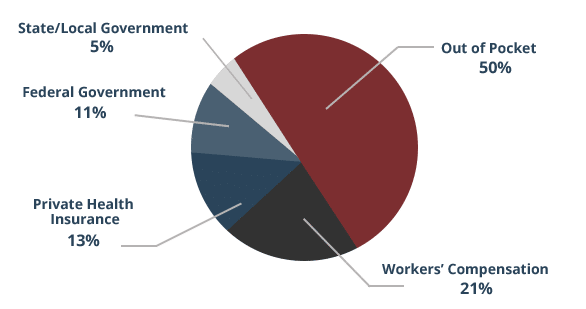
Who Bears the Cost Workplace Injuries?
Source: Occupational Safety and Health Administration
‘Broken’ Workers’ Comp Systems Lead to Income Inequality, Report States
 The focus of the report is how “broken” workers’ compensation systems force injured workers and their families down the socio-economic ladder.
 “These injuries and illnesses contribute to the pressing issue of income inequality: they force working families out of the middle class and into poverty, and keep the families of lower-wage workers from entering the middle class. Work injuries hamper the ability of many working families to realize the American Dream,” the report states.
OSHA goes on to describe how changes in state-based workers’ compensation insurance programs have made it increasingly difficult for injured workers to obtain benefits.
Even though more than three million workers are seriously injured, and thousands more are killed on the job each year, fewer than 40 percent of eligible workers apply for workers’ compensation benefits.
In the first decade after being injured on the job, the average injured worker can expect to lose 15 percent of his or her normal earnings, or $31,000 on average, the report states.
“[I]t is vitally important that state-based workers’ compensation programs take steps to eliminate roadblocks that prevent workers with compensable injuries or illnesses from receiving the full compensation to which they are entitled,” OSHA states.
Report Finds That Injured Workers Turn Elsewhere for Benefits
 Because of the difficulty of obtaining workers’ compensation benefits, a worker who is eligible for help under Medicare, Medicaid, veterans’ benefits or private insurance is more likely to seek those benefits instead.
The report also states that “at least part” of the growth in Social Security Disability Insurance (SSDI) benefits payments over the last several years is attributable to workers turning to the program’s subsidy for work injuries and illnesses as an alternative to workers’ compensation.
When an injured worker does obtain workers’ compensation, it only provides a small percentage (about 21 percent) of the overall cost of the injury or illness.
 Nearly 63 percent of the cost of occupational injuries and illness fall on workers, their families and their private health insurance, while taxpayers shoulder a large portion of the rest, according to OSHA. Through Medicare and Medicaid alone, taxpayers pay almost 19 percent of the medical costs of occupational injuries and illnesses.
Another Key Issue: Classification of Workers
Another factor in this cost-shift away from employers’ workers’ compensation insurance is the “pervasive misclassification of wage employees as independent contractors” and the “widespread use of temporary workers.”
Independent contractors are not eligible for workers’ compensation, and the employment agency would be responsible for a temporary employee’s workers’ compensation benefits.
 The report cites a McClatchy Newspapers series about misclassified workers in the construction industry, which found that the practice affected 15.5 percent of workers in Florida.
Use of misclassified and temporary workers also reduces the incentives for companies to assume responsibility for providing safe working conditions, which may result in increased overall risk of workplace injury, OSHA states.
Time after time, the report’s authors say the dire statistics they cite are conservative and do not reflect occupational injuries that are never reported, costs borne by injured workers’ family members and “less tangible effects that are important but impossible to monetize.”
The report points out that preventing workplace injuries and illnesses from occurring in the first place is the most effective solution to the problem. However, as long as they are able to shift the costs of injury and illness onto workers, their families and taxpayers, unsafe employers have fewer incentives to eliminate workplace hazards that lead to injuries and illnesses, according to OSHA.
Orlando Workers’ Compensation Attorney, Frank M. Eidson P.A., Provides Crucial Help to Workers
Regardless of the obstacles, Florida’s workers’ compensation program provides millions of dollars to tens of thousands of injured and ill workers every year.
 Most often, a successful claim is made only with the help of an experienced workers’ compensation attorney. This type of legal assistance will be more important as the trends outlined above continue.
 The workers’ compensation benefits attorneys of Frank M. Eidson, P.A., can provide this assistance to you in Orlando, Winter Park or elsewhere in Florida, working hard to pursue benefits you deserve.


